
PIANO EDUCATION INSIGHTS
An educational resource for parents, diploma candidates, teachers, and advanced learners on piano playing, teaching, artistry and musical development.
Great pianists are not shaped by practice alone. They are formed through thoughtful teaching, artistic imagination, disciplined listening, and a lifelong pursuit of musical excellence.
This collection presents Josephine Koh's professional perspectives on piano performance, pedagogy, musical development, and artistic interpretation. Drawing upon decades of international concert performance, conducting, teaching, curriculum development, and advanced pedagogical training, these articles examine the principles that cultivate confident performers, discerning musicians, and reflective teachers.
Many of the articles are accompanied by video commentaries and demonstrations, offering practical insights into technique, tone production, interpretation, performance preparation, and the artistic decisions that lie beyond the printed score. Together, they form an evolving body of educational resources for students, parents, teachers, and musicians who seek a deeper understanding of piano playing and musical artistry.
“Sometimes, the question is not about how much a student practises — but about how deeply and attentively they listen.”
About Josephine Koh
Josephine Koh is a Singapore-based concert pianist, conductor, music author, and pedagogue. As a Bösendorfer Artist and founder of the Josephine Koh Piano Academy and Joyeux Music Pedagogy Academy, she has devoted her career to nurturing pianists and teachers towards distinction in performance, diploma qualifications, and professional musical development.
Her educational philosophy is founded upon the integration of technical mastery, artistic sensitivity, critical listening, and musical integrity, enabling students not merely to pass examinations, but to become confident, expressive, and intellectually engaged musicians.
"The deepest musical growth begins when students learn not simply to practise more, but to listen more deeply, think more critically, and communicate with greater artistic conviction."

ABRSM or Trinity Piano Diploma: Which Path is Right for My Child
A better question is:
Which diploma route will bring out the student’s strengths, while developing the areas needed for serious musical growth? ABRSM and Trinity: Not Simply a Matter of Prestige. Both ABRSM and Trinity diplomas are respected internationally. Both can support advanced musical development. However, they are not identical in structure, repertoire approach, or performance expectation.
Passing Grade 8 with strong marks is a real achievement. But for serious pianists, it raises a more important question: what comes next?
At diploma level, the expectations change. The examiner is no longer listening only for accuracy, fluency, and secure technique. The student must now present a convincing performance programme with artistic maturity, stylistic understanding, tonal control, and the stamina to sustain a recital-level standard. This is why the common question, “Is ABRSM or Trinity easier?” is often the wrong starting point.
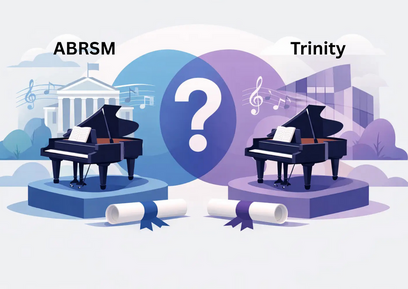
A better question is:
Which diploma route will bring out the student’s strengths, while developing the areas needed for serious musical growth?
ABRSM and Trinity: Not Simply a Matter of PrestigeBoth ABRSM and Trinity diplomas are respected internationally. Both can support advanced musical development. However, they are not identical in structure, repertoire approach, or performance expectation.
ABRSM may suit students who benefit from a more structured progression, especially those moving from Grade 8 into their first diploma. The ARSM can be a useful bridge for students who are technically advanced but still developing recital confidence.
Trinity may suit students who already think more naturally as performers. Its recital-based approach can be very rewarding for pianists with strong stage presence, musical personality, and the ability to shape a full programme convincingly.
Neither route guarantees success. The result depends far more on repertoire choice, preparation quality, musical maturity, and the student’s readiness.
The Core Difference Is Not Prestige.
It is fit.Parents sometimes ask which diploma carries more prestige. In practice, both are credible qualifications with international recognition. The better question is where the student is heading. If the goal is a carefully staged transition from Grade 8 into recital performance, ABRSM can appeal because its diploma ladder includes ARSM as a bridge. That step can be psychologically helpful for students who are technically advanced but not yet fully settled in large-scale presentation.
If the student is already playing with a strong sense of stage identity, Trinity may feel more natural. Its diploma culture has long emphasized the recital as a whole, not merely the completion of a demanding list. For some candidates, that creates a more musical frame of mind. For others, it exposes weaknesses in programming, pacing, or stylistic contrast.
This is where expert guidance matters. The same pianist might flourish under one system and underperform under the other, not because of ability, but because of repertoire choices and assessment fit.
Repertoire Choice Matters More Than Many Parents Realise
At diploma level, choosing pieces is not just about selecting works that are “difficult enough”.
The programme must suit the student’s hands, sound, temperament, musical imagination, and long-term goals. A brilliant young pianist may still struggle if the repertoire exposes technical weaknesses or lacks stylistic contrast. Another student may flourish because the programme has been carefully shaped around his or her strengths.
A diploma programme should show: control of tone, clarity of style, musical architecture, stamina, contrast, and artistic direction. This is where experienced guidance becomes essential. A poor repertoire decision can make a capable student appear less ready than he actually is.
Which Student Suits Which Route?
The most reliable answer is still: it depends. ABRSM offers ARSM, DipABRSM, LRSM, and FRSM. Trinity offers ATCL, LTCL, and FTCL. Parents sometimes ask which carries more weight. In practice, both are credible qualifications. The better question is which framework suits the student's artistic profile.
ABRSM's structured ladder — with ARSM as a bridge step — can be valuable for students who are technically advanced but still developing their large-scale recital confidence. The graduated pathway gives them clear targets and a psychologically supportive route upward.
Trinity's recital-centred approach may suit students who already think in terms of musical narrative — those with strong stage instincts and a vivid sense of interpretive character. Its flexibility in programme-building can be an advantage, but only when there is a teacher with the curatorial judgment to shape it well.
Students aiming eventually for conservatory auditions should think beyond the next certificate. Which route is more likely to develop a persuasive audition profile? Which repertoire can be carried forward and deepened? Which diploma framework supports not only a pass or distinction, but the making of a credible young artist?
Diploma Preparation at Josephine Koh Piano Academy
At Josephine Koh Piano Academy, diploma preparation is approached as advanced performance formation, not merely exam coaching. Students are guided in repertoire selection, technical refinement, tone production, stylistic understanding, performance confidence, and long-term musical development. The aim is not simply to enter an exam, but to prepare the student to play with conviction, maturity, and authority.
For advanced students in Singapore, this planning is especially important. School workload, competition schedules, theory development, university goals, and performance opportunities all affect the right timing. A diploma taken too early may produce a certificate without real artistic maturity. A diploma taken at the right time can transform a student’s playing.
What's Next?
If your child is approaching Grade 8 completion and you are beginning to consider diploma pathways, contact us for a consultation session or an audition. An honest assessment of current repertoire, technical reliability, concert experience, and artistic temperament will point towards the right path and the future plans.