
PIANO EDUCATION INSIGHTS
An educational resource for parents, diploma candidates, teachers, and advanced learners on piano playing, teaching, artistry and musical development.
Great pianists are not shaped by practice alone. They are formed through thoughtful teaching, artistic imagination, disciplined listening, and a lifelong pursuit of musical excellence.
This collection presents Josephine Koh's professional perspectives on piano performance, pedagogy, musical development, and artistic interpretation. Drawing upon decades of international concert performance, conducting, teaching, curriculum development, and advanced pedagogical training, these articles examine the principles that cultivate confident performers, discerning musicians, and reflective teachers.
Many of the articles are accompanied by video commentaries and demonstrations, offering practical insights into technique, tone production, interpretation, performance preparation, and the artistic decisions that lie beyond the printed score. Together, they form an evolving body of educational resources for students, parents, teachers, and musicians who seek a deeper understanding of piano playing and musical artistry.
“Sometimes, the question is not about how much a student practises — but about how deeply and attentively they listen.”
About Josephine Koh
Josephine Koh is a Singapore-based concert pianist, conductor, music author, and pedagogue. As a Bösendorfer Artist and founder of the Josephine Koh Piano Academy and Joyeux Music Pedagogy Academy, she has devoted her career to nurturing pianists and teachers towards distinction in performance, diploma qualifications, and professional musical development.
Her educational philosophy is founded upon the integration of technical mastery, artistic sensitivity, critical listening, and musical integrity, enabling students not merely to pass examinations, but to become confident, expressive, and intellectually engaged musicians.
"The deepest musical growth begins when students learn not simply to practise more, but to listen more deeply, think more critically, and communicate with greater artistic conviction."
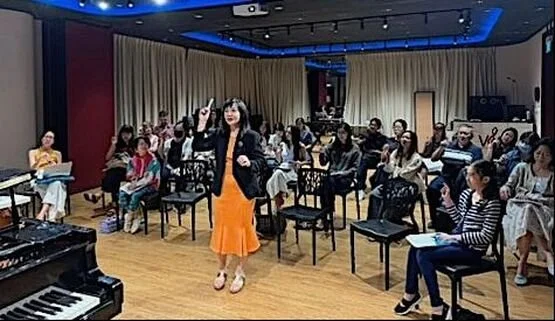
How to Prepare for ARSM Diploma Exam
For the ARSM examination, many post-Grade 8 pianists soon discover that the exam requires a sustained recital of approximately 30 minutes, demonstrating artistic authority and a level of control developed over a carefully planned period of time. It is not simply about assembling a number of pieces to fit the duration.
If you are wondering how ARSM preparation differs from graded piano exams, the answer lies not in quantity of practice, but in the curation and preparation of a programme at a higher technical and musical level, with clear artistic purpose.
For the ARSM examination, many post-Grade 8 pianists soon discover that the exam requires a sustained recital of approximately 30 minutes, demonstrating artistic authority and a level of control developed over a carefully planned period of time. It is not simply about assembling a number of pieces to fit the duration.
If you are wondering how ARSM preparation differs from graded piano exams, the answer lies not in quantity of practice, but in the curation and preparation of a programme at a higher technical and musical level, with clear artistic purpose.

WHAT THE ARSM PIANO EXAM IS ABOUT
The ARSM is often described as the first level performance diploma, with expectations that differ significantly from graded examinations. At this level, the candidate is expected to present a convincing programme with sustained concentration across contrasting works and movements. The performance should demonstrate stylistic awareness, musical continuity, and artistic control. A strong ARSM recital reflects:
Fluency and continuity across the entire programme
Thoughtful pacing between pieces and movements
Control of touch and tone
Clear stylistic understanding across periods
Variety in tempo, mood, and character
HOW TO PREPARE FOR THE ARSM PIANO EXAM
Before finalising examination repertoire, students should begin by exploring a selection of works from different composers and stylistic periods listed in the ARSM syllabus.
These initial pieces do not necessarily become the final programme. Instead, they serve to broaden musical understanding and develop repertoire familiarity at the required level.
While students are often drawn to pieces they admire, repertoire selection should also take into account:
Suitability to the student’s personality and musical voice
Technical readiness and long-term development
The ability to communicate the work convincingly
Students may begin with repertoire within their current ability and gradually progress to more demanding works over time.
BUILDING A BALANCED PROGRAMME
A well-constructed ARSM programme typically includes works from three to four stylistic periods. For example:
Baroque: Scarlatti, Handel, or Bach
Classical: A multi-movement sonata by Haydn, Mozart, or Beethoven (approximately 12–16 minutes)
Romantic: Schubert, Chopin, Brahms, Liszt, or Tchaikovsky
Modern/20th-century: To complete the programme
This combination allows the candidate to demonstrate:
Rhythmic and textural variety
Stylistic contrast
Tonal refinement
Expressive depth and musical character
The goal is not simply variety, but coherence and artistic authority across the entire recital.
CHOOSING THE RIGHT LEVEL OF CHALLENGE
Candidates should avoid both extremes:
Selecting only the most difficult works, which may lead to instability and discouragement
Choosing overly safe repertoire, which may lack substance and artistic depth
A well-balanced programme should:
Stretch the student technically
Include more intimate or lyrical works that reflect musical sensitivity
Demonstrate thoughtful artistic judgement
THREE CORE AREAS OF PREPARATION
Once the repertoire is selected, preparation should proceed along three parallel tracks:
Technical Security
Musical Decision-Making
Performance Conditioning
Without these, progress often plateaus.
DEVELOP INTERPRETATION EARLY
A common weakness in ARSM preparation is leaving musical interpretation until after the notes are learned. By then, the performance often becomes fixed and overly literal. Musical decisions—such as phrasing, articulation, voicing, dynamics, and tonal control—must be developed from the very beginning.
At diploma level, stylistic awareness is essential. The approach to sound, touch, and pedalling differs significantly between composers such as Bach, Beethoven, Chopin, Debussy, and Prokofiev.
TRAIN LIKE A RECITAL PIANIST
Since ARSM is presented in recital format, preparation must reflect the ability to sustain a full programme at a high level.
Playing individual pieces well is not enough. The challenge lies in delivering a convincing sequence of works.
Students must develop:
Physical stamina
Mental focus
Emotional control
Full programme run-throughs are essential. They expose issues such as fatigue, memory lapses, and tension affecting sound quality.
THE PREPARATION TIMELINE
Many students approach ARSM without a structured timeline. Effective preparation should include:
Learning phase
Technical and musical refinement
Memorisation
Full run-through training
Recording practice
Final consolidation
The Role of Guided Training
At advanced levels, structured guidance becomes crucial.
At Josephine Koh Piano Academy, the focus is not merely on passing the exam, but on achieving a performance standard that can withstand professional scrutiny. Through performance classes, concerts, competitions, and mock examinations, students learn to perform under varied conditions—an essential component of diploma preparation.
Final Weeks: Live or Recorded Exam
In the final phase, avoid over-practising. Instead:
Focus on fluency and consistency
Refine technical security
Maintain clarity of musical intention
For recorded submissions, allow sufficient time for multiple takes—without turning the process into a battle of exhaustion.
Final Thoughts
ARSM rewards students who have truly stepped into the role of a performer.
This growth is reflected in:
The quality of sound
The pacing of the programme
The authority of the performance
Beyond being a qualification, ARSM preparation represents a genuine artistic transformation.