PIANO EDUCATION INSIGHTS
An educational resource for parents, diploma candidates, teachers, and advanced learners on piano playing, teaching, artistry and musical development.
Great pianists are not shaped by practice alone. They are formed through thoughtful teaching, artistic imagination, disciplined listening, and a lifelong pursuit of musical excellence.
This collection presents Josephine Koh's professional perspectives on piano performance, pedagogy, musical development, and artistic interpretation. Drawing upon decades of international concert performance, conducting, teaching, curriculum development, and advanced pedagogical training, these articles examine the principles that cultivate confident performers, discerning musicians, and reflective teachers.
Many of the articles are accompanied by video commentaries and demonstrations, offering practical insights into technique, tone production, interpretation, performance preparation, and the artistic decisions that lie beyond the printed score. Together, they form an evolving body of educational resources for students, parents, teachers, and musicians who seek a deeper understanding of piano playing and musical artistry.
“Sometimes, the question is not about how much a student practises — but about how deeply and attentively they listen.”
About Josephine Koh
Josephine Koh is a Singapore-based concert pianist, conductor, music author, and pedagogue. As a Bösendorfer Artist and founder of the Josephine Koh Piano Academy and Joyeux Music Pedagogy Academy, she has devoted her career to nurturing pianists and teachers towards distinction in performance, diploma qualifications, and professional musical development.
Her educational philosophy is founded upon the integration of technical mastery, artistic sensitivity, critical listening, and musical integrity, enabling students not merely to pass examinations, but to become confident, expressive, and intellectually engaged musicians.
"The deepest musical growth begins when students learn not simply to practise more, but to listen more deeply, think more critically, and communicate with greater artistic conviction."
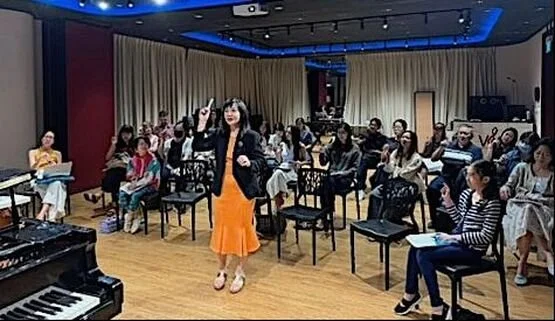
Diploma Piano Lessons in Singapore: What serious students Really Want
A student who is able to perform a Liszt or Chopin etude or play at Grade 8 level with Distinction scores or beyond is no longer looking for a routine weekly piano lesson. At this stage, the focus is not simply on learning notes or completing pieces. It is about advanced piano playing - developing control, musical understanding, and the ability to perform consistently under examination and performance conditions.
Advanced or Diploma level
piano study requires a different level of training. Technique must be refined with precision, musical decisions must be intentional, and preparation must align with the demands of diplomas, competitions, and public performance.
The role of the teacher also changes. It is no longer someone who simply go about guiding repertoire, but about shaping the student’s artistic development with clarity, structure, and long-term direction.
What does advanced piano study involve?
Many parents often assume that a student becomes “advanced” after completing Grade 8. In reality, this is only the beginning of advanced musical study. .Some students arrived at Grade 8 or even attained ARSM with reliable technique but limited musical understanding. Others show strong musical instinct earlier, even before completing the full graded examination pathway. True advanced study begins when technique, interpretation, theory, and performance preparation function together as an integrated whole.
Diploma piano lessons should address tonal control, voicing, pedalling, rhythmic stability, stylistic awareness, memorisation, and performance readiness. Diploma examination pathways such as ARSM, ATCL, LTCL, LRSM, FRSM and FTCL require similar level of integration.
A student working on major repertoire — whether Bach, Beethoven, Chopin, or larger concert works — requires a different level of attention. The margin for error is smaller, and every weakness can become more apparent.
Why advanced piano training requires professional coaching?
While there are many piano teachers available, advanced/diploma training is a specialised scope of work. At this level, students need a performer-teacher who can identify technical and musical issues accurately, demonstrate effectively and provide structured practice solutions. Experience in performance and examination become important, as the expectations are much more clearly defined.
The difference between enrichment and serious training.
Not every student at this level requires the same pathway. Some may wish to maintain a good standard while enjoying repertoire. Others may be working towards specific goals — distinction at Grade 8, diploma examinations, concerts or competition preparation. The structure of lessons should reflect this.
Serious training requires discipline, attention to detail, and a willingness to refine work repeatedly. This includes revisiting technical passages, adjusting interpretation, and developing consistency across performances. For the right student, this process is not restrictive. It provides clarity and direction.
What to expect from Advanced or Diploma piano lessons
At an advanced level, lessons should form part of a structured system rather than just a weekly review of pieces.
This includes:
Carefully planned repertoire selection that builds weaknesses, and pieces that develop the strength of the student
Technical work aligned to the demands of the music and deeper foundations
Integration of music theory concertps and musical understanding
Listening and stylistic awareness
For students preparing for recorded examinations, additional preparation is required. Performing for recording demands consistency, control, and the ability to reproduce a reliable performance without the presence of an audience.
The importance of teacher profile and approach
At this stage, the choice of teacher becomes particularly important.
A focused, founder-led studio offers a clear teaching approach and consistent standards. This allows students to work within a defined system, rather than a general or fragmented approach.
A method that combines technical discipline with strong musical understanding encourages not only accuracy, but also depth of interpretation and tonal control. For students preparing for higher-level examinations and performance, this level of training is essential.
Recognising readiness for advanced study
Readiness for advanced training depends not only on ability, but also on approach.
Students should show:
Responsiveness to correction during lessons
Willingness to practise carefully with the right habits
Patience in refining details
Consistency in listening to rhythm, balance, texture and tone
Developing musical awareness for different composers and genres within piano music.
If these are not yet present, it is often more effective to strengthen foundations before moving forward. This leads to more secure progress over time.
Choosing a pathway for long-term development
There is no single pathway for every student. At Josephine Koh Piano Academy, located at Bukit Timah, the graded level students would aim to achieve distinction in Grade 8. As we prepare students for diploma exams, concert performance and competitions with a strong mental focus, we ensure that real artistic development takes place over time.
We believe that with our well-guided approach, while our students continue to excel and achieve examination results, they develop into confident and thoughtful young adults, with sustained love for music.
Advanced Piano Training in Singapore
For students seeking serious musical development — whether towards diploma examinations, performance, or deeper artistic understanding — structured guidance makes a significant difference.
Piano and Music Theory Lessons are available in Bukit Timah, Singapore, with a focus on:
Diploma-level preparation (ABRSM, Trinity)
Performance refinement and interpretation
Individualised musical development