
Grades 6 to 8 Music Theory, Why You Need It
A student in Music Elective Programme or learning at LRSM or LTCL level who can play a Beethoven sonata fluently may still lack musical conviction if their theory foundation is weak.
In Singapore, many students stop theory after Grade 5. It is often treated as a requirement to “get over and done with,” rather than as an essential part of musical training. However, at advanced stages, this gap becomes increasingly obvious.
Music theory is not a secondary subject. It is essential at advanced practical studies. It shapes how a student understands music, thinks about structure, and develops as a musician over time with stronger musicianship, and long-term artistic authority.

Why Theory Matters Beyond Grade 5
For students progressing into Grades 6 to 8, theory becomes far more than written work. It directly influences:
How music is read and understood
How phrases are shaped and balanced
How harmony is perceived
How securely music is memorised
Without this foundation, performance often lacks depth and clarity, even if the notes are correct. Students learn how chords are written and how they function, why a cadence changes the emotional weight of a phrase, how modulation affects architecture, and how stylistic writing differs across periods. This kind of training supports not only written papers but also performance maturity.
What Advanced Theory Training Should Include
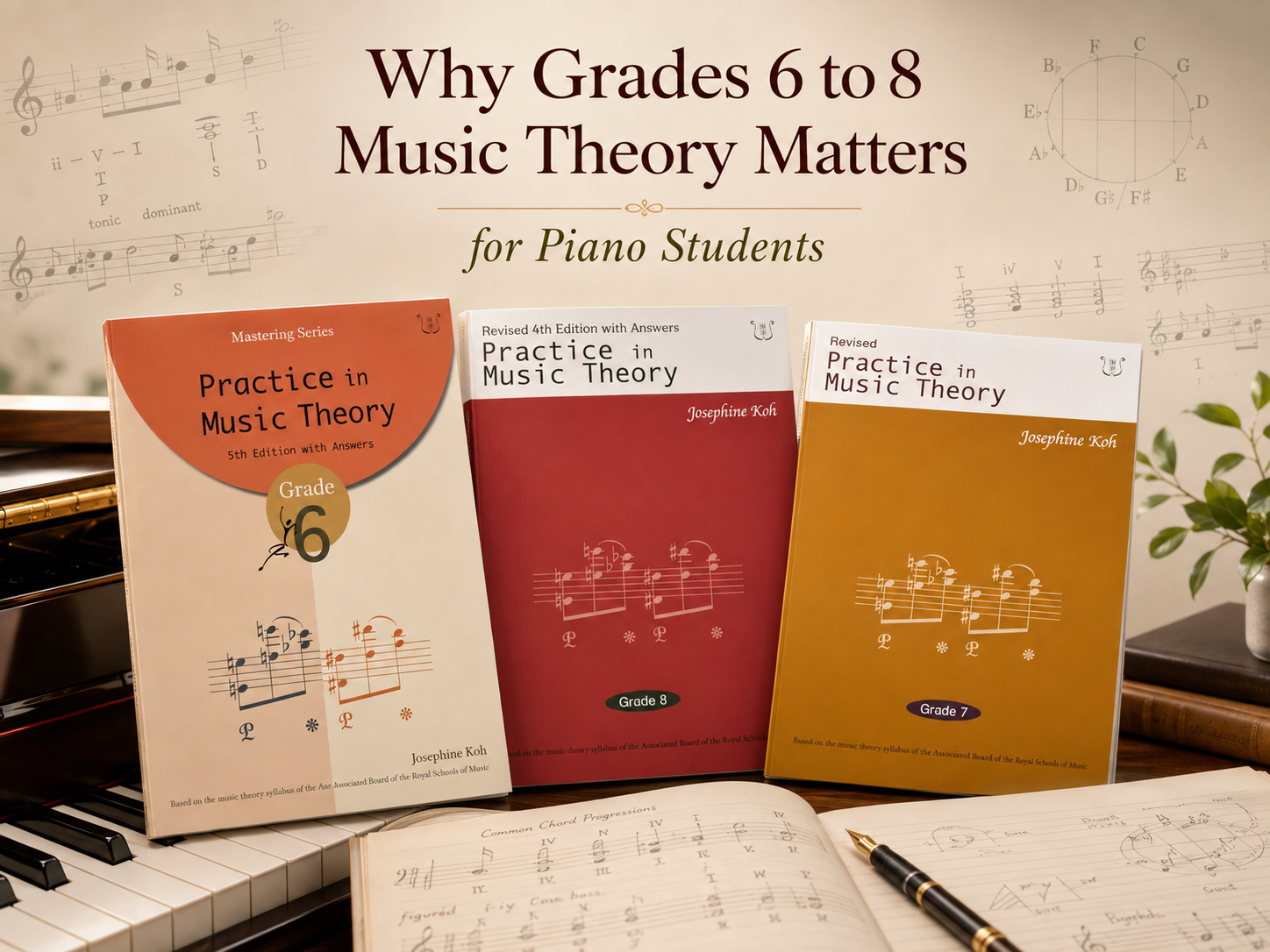
Many parents prefer theory programmes that focus primarily on rushing to finish Grade 8. They do not know that while this may be adequate for up to Grade 5, it is not the right approach for students aiming for higher musical standards.
At Grades 6 to 8, music theory must be taught through real musical context. Students are introduced to concepts through:
Harmonic principles from Jean-Philippe Rameau
J. S. Bach's Chorales
Analysis of works across different musical periods
Learning is cumulative and structured. Students move beyond identifying elements on the page to understanding how music is constructed and how it functions. Concepts are connected to current repertoire, making learning more meaningful. Elite instruction identifies each student's specific needs and trains them individually, often effective in a group class setting.
How Theory Affects Performance
Weak theory eventually appears in advanced performance as insecure memory, shallow phrasing, or pedalling that ignores harmonic change. These aren't just technical issues—they reflect deeper musical understanding gaps.
When students understand tonal structure and compositional design, interpretation becomes more intelligent. This matters greatly in diploma recitals, competitions, and auditions where musical decisions must be convincing.
At Josephine Koh Piano Academy
Our theory teaching is exacting and progressive. Students are expected to think, not merely copy procedures. We connect theory to repertoire—whether Bach, Mozart, Chopin, or Debussy — illuminating texture, harmonic colour, cadence patterns, sequence, modulation, and stylistic syntax. This deepens understanding of a work while making concepts easier to retain.
Who Benefits Most
Students aiming beyond Grade 8, those in music elective programmes, and diploma-track students (LTCL, LRSM, FTCL, FRSM) benefit most from serious theory training. For diploma students especially, theory shouldn't be an afterthought—it supports analytical maturity and stronger artistic communication. Thus the written and practical disciplines reinforce each other.
At Josephine Koh Piano Academy, this standard is understood as part of advanced musical formation rather than an isolated exam task. That distinction matters when expectations are high.
Does My Child Need Grade 8 Theory?
Yes, if they're ambitious and aim to excel in music. Without structured theory training, learning is incomplete. Theory provides the framework supporting higher-level thinking, interpretation, and artistic control.
Choosing the Right Programme
At Josephine Koh Piano Academy, our programmes are designed for advanced outcomes. Our focused theory classes :
Set clear expectations
Maintain high standards
Emphasise understanding, not memorisation
Provide structured and progressive learning
Final Thoughts
Students who learn to hear structure, write accurately, and think musically gain more than exam results—they gain clarity, control, and confidence. At higher levels, this understanding allows true musicianship to develop.
At Josephine Koh Piano Academy, we treat theory and performance as interconnected disciplines essential for advanced musical formation.