
Piano Lessons for Gifted Children: How Talent is Trained
Gifted children may not need more encouragement to practice. When parents begin searching for piano lessons for gifted children, the real question is not whether the child has talent, but whether that talent will be shaped with sufficient seriousness, technical structure, and artistic intelligence to endure. Giftedness at the piano is often misunderstood.
Watch the full talk and read the article below:
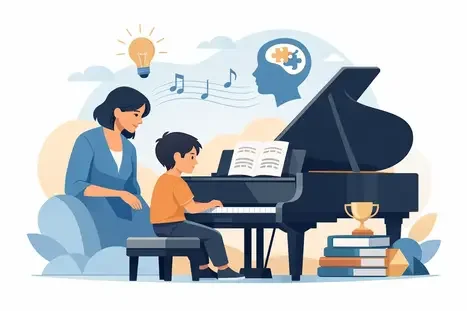
A child may memorise quickly, hear harmonies instinctively, or play with striking musical imagination far beyond age expectations. These are promising signs, but they are not a substitute for disciplined training. In fact, gifted students often require more exacting instruction. Giftedness at the piano is often misunderstood. A child may memorise quickly, hear harmonies instinctively, or play with striking musical imagination far beyond age expectations. These are promising signs, but they are not a substitute for disciplined training. In fact, gifted students often require more exacting instruction. Without strong guidance, natural facility can conceal weak reading skills, undeveloped technique, poor physical habits, and shallow musical or theoretical understanding.
This video is part of the Piano Pedagogy Talks series, which reflects on key questions in music education, performance training, and teaching philosophy.
A gifted child does not simply need lessons that keep them engaged. They require a structured path that develops musical personality, control, endurance, interpretation, and readiness for the stage.
The Craft of Nurturing Gifted Children
There are many programmes for gifted children worldwide, including institutions such as the Central Music School in Russia. The underlying philosophy is consistent: talent is treated as raw material—not flattered, but developed.
Lessons must move beyond basic note learning and weekly repertoire completion. A serious programme for an able young pianist should build technical discipline through scales, arpeggios, double notes, chord balance, voicing, and tonal control. At the same time, it must cultivate stylistic awareness across a wide range of repertoire—from Bach and Mozart to Chopin and Prokofiev—exposing the student to entirely different sound worlds, gestures, and architectural thinking.
This is where many students plateau. They are praised for being advanced, yet are not trained to conservatoire-level expectations. They may attempt difficult repertoire prematurely, without sufficient work on structure, sound production, and score study. The result is playing that appears impressive on the surface but becomes increasingly unstable as repertoire grows more demanding.
Gifted children call for a different teaching approach
Gifted children are not always easy to teach. Quick learners may become careless, relying excessively on the ear rather than reading accurately. Teaching must therefore be exact without being overly critical, and ambitious without being reckless. This balance is one of the defining characteristics of elite training.
Fast progress can conceal technical gaps
Many gifted students appear advanced because they learn repertoire quickly. However, speed of learning is not equivalent to depth of training. A serious teacher must identify issues early. Technical work must be assigned with purpose—to build a strong foundation capable of sustaining advanced repertoire and public performance.
Musical instinct must be supported by language
Some gifted children play expressively from the outset, yet lack the ability to articulate harmony, phrase structure, modulation, cadence, or form. This gap becomes critical at higher levels.
Students progressing towards diploma examinations, competitions, and recital performance require strong musical understanding to support their playing.
Music theory and musicianship cannot be treated as secondary subjects. For serious young pianists, they sharpen interpretation, strengthen memory, improve reading, and provide control rather than guesswork.
Choice of repertoire in advanced development
Repertoire selection is one of the most revealing aspects of a gifted student’s training. A teacher who specialises in advanced students selects works that address specific technical and musical objectives in sequence. One piece may develop contrapuntal clarity, another tonal layering, another rhythmic control, and another long-form structural awareness.
This approach may appear less glamorous than assigning virtuosic works, but it is far more effective in the long term.
Acceleration may be appropriate for truly exceptional students. However, it must be supported by careful technical planning and growing interpretative maturity. Otherwise, repertoire becomes a display of ability rather than a vehicle for artistic development.
What to look for in piano lessons for gifted children
Parents do not need to be musicians to recognise the need for serious training. They should observe whether the teacher’s environment upholds meaningful standards. Gifted children benefit from teachers who are artistically accomplished, technically informed, and experienced in long-term development—extending into advanced study, diplomas, competitions, and performance.
Equally important is suitability. Some children thrive in demanding environments and welcome precise critique, while others require a more gradual transition into high-level expectations. Progress depends on temperament, prior training, and the level of commitment within the home. Sustained development requires more than a weekly lesson; it requires consistency and structure in daily practice.
Examinations, diplomas, and performance goals
For gifted students, examinations and credentials are not ends in themselves. They provide valuable structure that prevents complacency and clarifies progress.
Beyond playing the notes, students must cultivate touch, tone, stylistic understanding, memory, and performance stability under pressure.
At Josephine Koh Piano Academy, students are trained in performance classes in addition to weekly lessons. They develop artistic maturity, structural awareness, and performance resilience. Over time, a studio culture is established that prioritises refinement over shortcuts.
Realistic observations about gifted children
In practice, different trajectories emerge. Some children receive disciplined, structured training and develop into exceptional musicians. Others possess genuine potential, but when lessons are taken less seriously and academic demands take priority, that potential gradually diminishes during the teenage years.
As repertoire becomes more demanding, the level of commitment, discipline, and perseverance required increases significantly. At this stage, natural ability alone is no longer sufficient.
Long-term development requires sustained guidance. The integration of technique, theory, stylistic awareness, and musical understanding within practical lessons ensures that the student matures at an appropriate pace. The child must learn to make musical judgments independently, rather than relying solely on imitation.
Challenges Along the Way
The process is not without difficulty. Students must learn to navigate setbacks, revisit repertoire, and work consistently towards higher standards over time.
Giftedness is not a final condition. It is potential under pressure. Some students rise because they develop depth, technique, and resilience. Others plateau because early ease was never transformed into structured capability.
Parents who recognise unusual musical ability in their child often choose to invest seriously in their education. However, the correct approach is not simply acceleration accompanied by praise. It is the careful calibration of expectations, supported by excellent teaching and meaningful standards.
A gifted young pianist should leave each lesson with more than enthusiasm. They should leave with sharper listening, clearer thinking, stronger technique, and a growing sense of artistic responsibility.
That is how talent becomes musicianship, and how potential evolves towards mastery.