
Recorded or Live Exams: Which is Right for the Students?
One of the most common questions parents and students ask, is whether a recorded or a live exam is "easier".
It is a very understandable question. In recent years, recorded exams appear convenient, less intimidating, and perhaps even safer. The student can play on a familiar piano, in a familiar room, and record more than once.
Beyond convenience and familarity, the real question is not, “Which format is easier?” but, “Which format will help the student present his best?
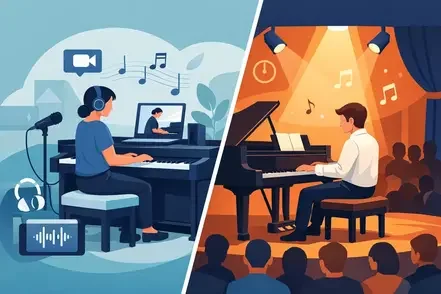
While both formats follow the same syllabus, the experience is very different. A recorded exam offers flexibility and playing through multiple takes. It is not uncommon to find students losing shape and freshness - after repeated attempts. A live exam, however, creates a real performance situation. It trains the aspiring and ambitious pianist more rigorously - to deliver consistently at a high performance standard.
THE VALUE OF A LIVE PIANO EXAM
A live exam remains the clearest test of performance readiness. It rewards students who can enter the room, settle quickly, and present their work with discipline. For advanced classical pianists, that skill matters beyond exams. Competitions, auditions, festivals, and (https://www.jkmusicstudio.com/diploma-piano-lessons.html) all depend on real-time execution.
There is also a musical advantage. In a live setting, students are often more likely to sustain a complete interpretive arc. They cannot stop to fix a slip or chase a cleaner version. As a result, they learn to think in larger phrases and broader structures. Serious performers need that mindset. Examiners can often tell when a student is communicating a full musical intention rather than delivering a carefully managed sequence of safe moments.
Live exams also encourage mental toughness. That does not mean glorifying anxiety. It means training the student to function with steadiness when the stakes rise. In conservatoire-style preparation, this is not optional. A pianist aiming for high grades and diplomas must eventually become reliable in public conditions.
THE LIMITATION OF RECORDED EXAMS
Recorded exams can certainly be useful. They provide flexibility, and for most students, they reduce the stress of a formal exam environment. With the student in a familiar environment and fewer constraints, there is no pressure to produce the best performance once - in real time - under formal conditions.
My concern is that students who are not exposed to live performance situations often struggle later when they face competitions, auditions, recitals, or diploma-level expectations. They may be able to produce a good recording, but they have not yet learnt how to cope with the pressure and unpredictability of a real event.
WHEN A RECORDED PIANO EXAM CAN BE THE RIGHT CHOICE
A recorded exam is a secured option for students who are musically prepared, but not emotionally strong and stable yet to be in a formal examination condition. For many students, the camera reduces the emotional stress caused by travel, waiting time, unfamiliar environment, and the examiner’s physical presence. That calmer environment offers a level of familarity and comfort.
For busy families, internationally mobile learners, or students balancing school demands with a serious music schedule, recording exams offers flexibility without lowering artistic expectations.
However, preparing the "perfect" recording can have its own frustrations. Some students and teachers spend several weeks recording and re-recording, making corrections and chasing the "perfect take". Others start to play over cautiously, ensuring accuracy of the notes at the expense of tone, line, and character. In the end, the performance may be 'note perfect' but musically lacking.
WHEN RECORDED EXAMS ARE APPROPRIATE
There are times when I would recommend a recorded exam.
If school examinations or important schedules clash with the live examination period, a recorded exam may be the most practical option. It allows the student to continue progressing without unnecessary disruption.
Recorded exams can also benefit students who might otherwise not attempt or complete an examination that seems daunting. For these students, the recorded format provides an alternative path towards achievement.
PREPARING FOR A RECORDED PIANO EXAM
Students often underestimate how demanding recording can be.
Good recording preparation begins much earlier than the filming day. Repertoire must be stable enough to survive repetition without becoming mechanical. Memory must be secured. Tempo choices must be realistic. Endings and transitions need special attention to avoid unexpected collapse.
The physical setup matters too. Instrument quality, camera angle, sound clarity, page-turn planning, bench position, attire, and room distractions all affect the final result. More importantly, the student must have practiced performing complete takes.
MY PROFESSIONAL VIEW ON EXAM FORMAT
Wherever possible, I favour live exams. A recorded exam can provide a safety net; which very likely can become a permanent comfort zone. For the aspiring and ambitious pianist, growth comes from being stretched. The student needs to learn how to perform in a formal setting, on a different piano, before a real examiner, with all the discipline and presence that the occasion requires. This is how confidence is built. This is how resilience is formed.
This is how a student becomes not only someone who can pass an exam, but someone who can truly perform.
At Josephine Koh Piano Academy, the choice of exam format is always considered carefully. We look at the student’s level, maturity, schedule, performance experience, and long-term goals. But for serious students, especially those preparing for higher grades, diplomas, competitions, auditions, and future performance opportunities, the live examination route offers the deeper training.
Beyond live exams, public masterclasses, concerts and competitions are training grounds for the ambitioius pianists who can grow to communicate with confidence, presence, and artistry in the real world.